Whrever: A Postmortem of the Mall on the Internet
· startup, product, architecture, web3, rewards

| What | One place to shop, stream, eat and hang out online, with rewards (JUICE) for all of it |
| Who | Julian “LOGIK” Gilliam (CEO) and me (CTO), co-founders |
| When | October 2023 to April 2025 |
| Best result | Final round of a16z crypto’s Crypto Startup Accelerator (CSX), spring 2025 cohort |
| Status | Paused. The pre-seed round didn’t come together, and without it there was no runway to keep building. |
The idea was easy to explain and hard to build. Everyone’s internet is split across a dozen apps: one to shop, one for music, one for food, one for news. Every brand runs its own loyalty program, and none of them talk to each other. Whrever was going to be the place where all of it happened, and where everything you did there earned you something.
This is a postmortem in the engineering sense: what we built, what we decided and why, what went right, and what didn’t.
Timeline
| When | What happened |
|---|---|
| Oct 2023 | First notes, and the first outreach to lawyers |
| Nov–Dec 2023 | Counsel engaged, incorporation started. Version 1 designed as a prototype walkthrough, plus a grant proposal for ApeCoin DAO (written, never submitted) |
| 2024–25 | The world dropped; Whrever pitched as a rewards super-app. Pitch decks, investor outreach, and the final round of a16z crypto’s CSX, spring 2025 cohort |
| Apr 2025 | The production repo started: a Next.js client and an Express API |
| Apr 2025 | Paused |
Version 1: a bazaar you could walk through (2023)
The first Whrever was a world. You landed on a map, picked a district, and walked into places: an artist’s studio, a sneaker shop, a listening room. Each place held real products from the people and brands behind it.
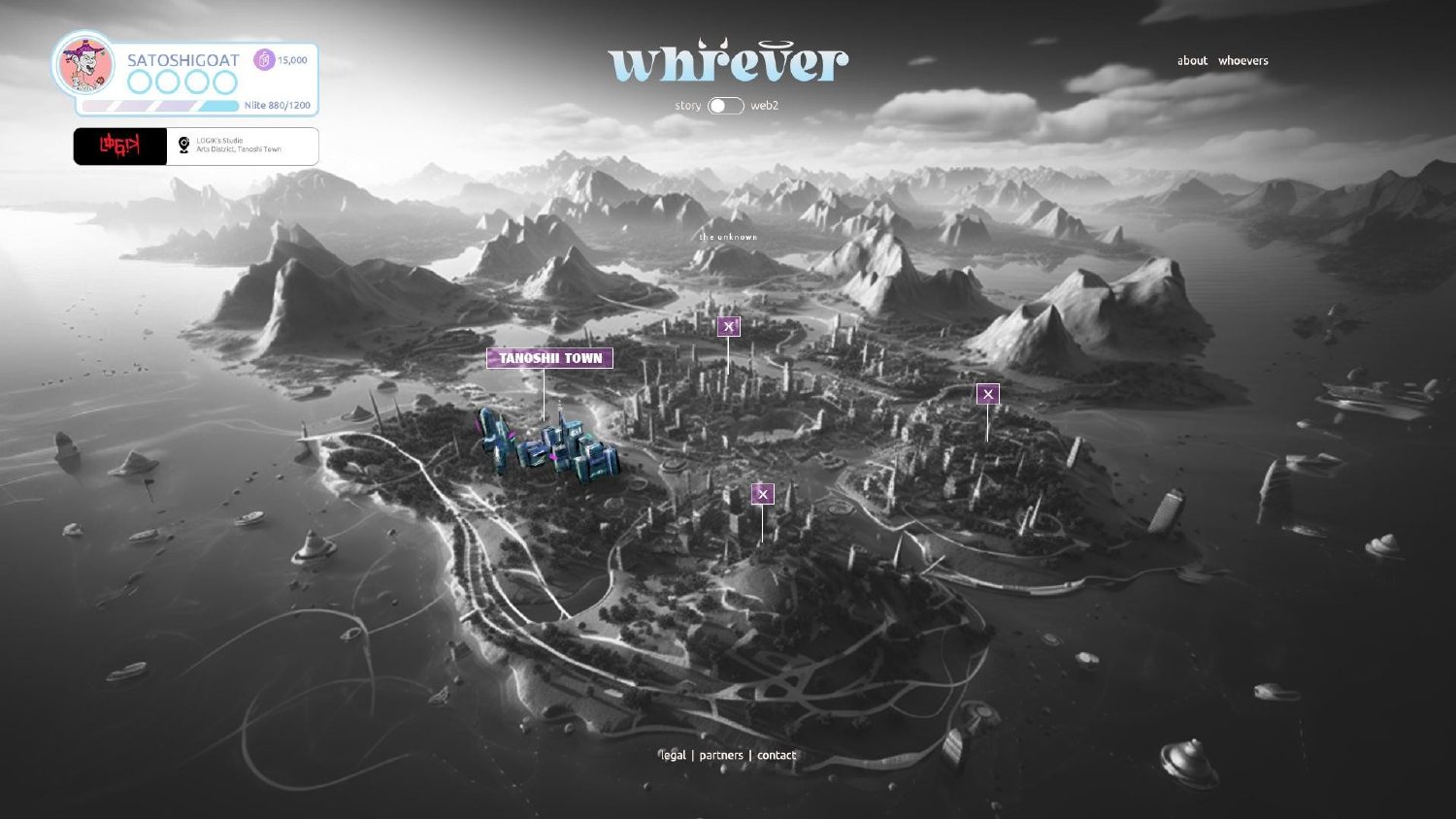
That switch was the most important design decision in version 1. Some people want the story, and some just want the product. Our proposal said it more bluntly: “Some people just want the d*mn product.” So every place in the world was also a plain catalog page, one toggle away. We called the result “Web2.5”: crypto-native under the hood, a normal store on top, with fiat and crypto at the same checkout through an on-ramp.
Your character in the world was a Whoever, one of 8,888 dynamic NFTs drawn by LOGIK. Their eyes evolved as they gained “enlightenment,” guided by the same two figures from GUD & EVOL. Owning one let you earn Juice, the platform’s currency. It’s the same word The Plug used for loyalty. Your Whoever also had a closet: buy a hoodie in real life, and a digital copy showed up on your character.
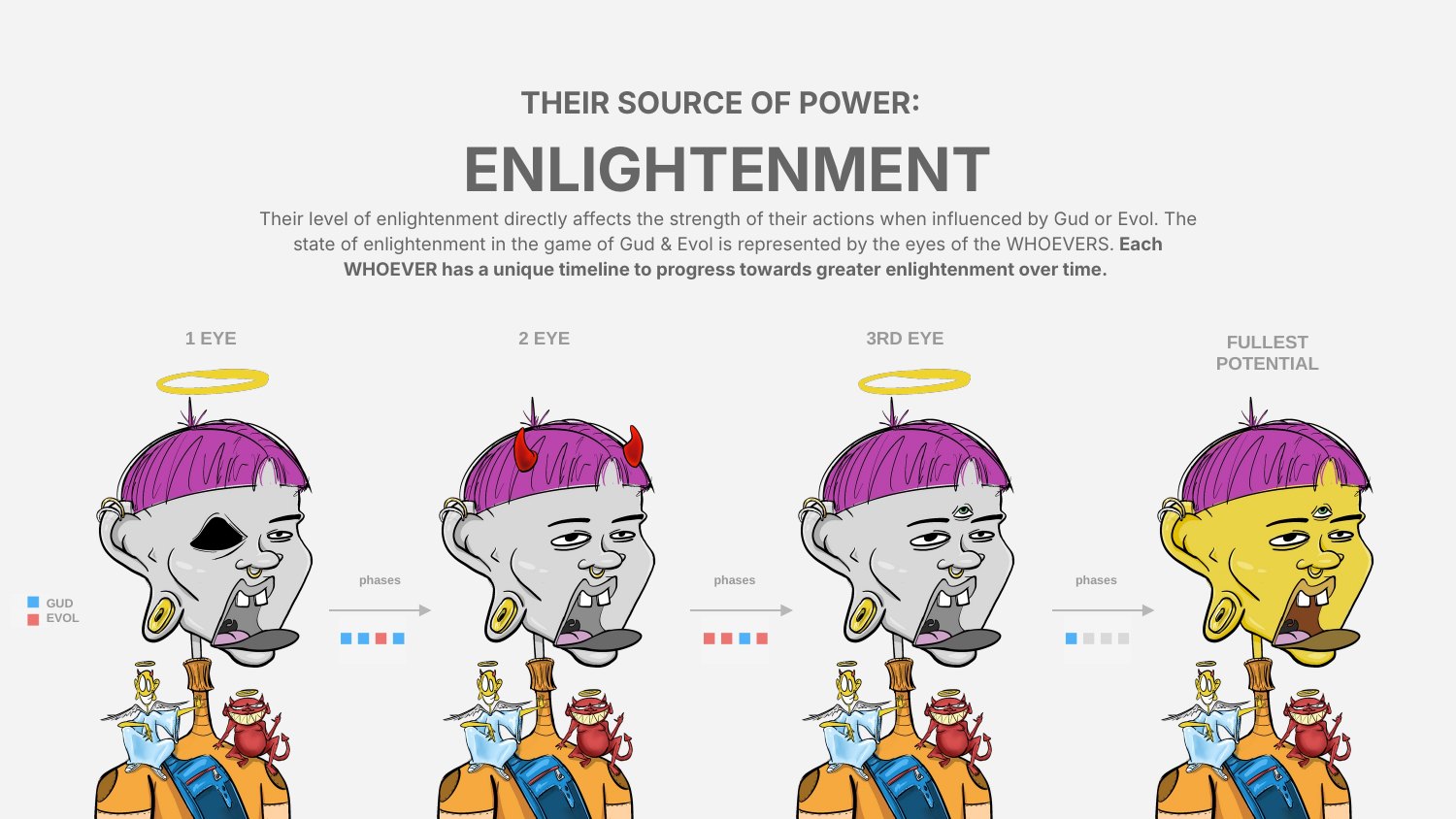
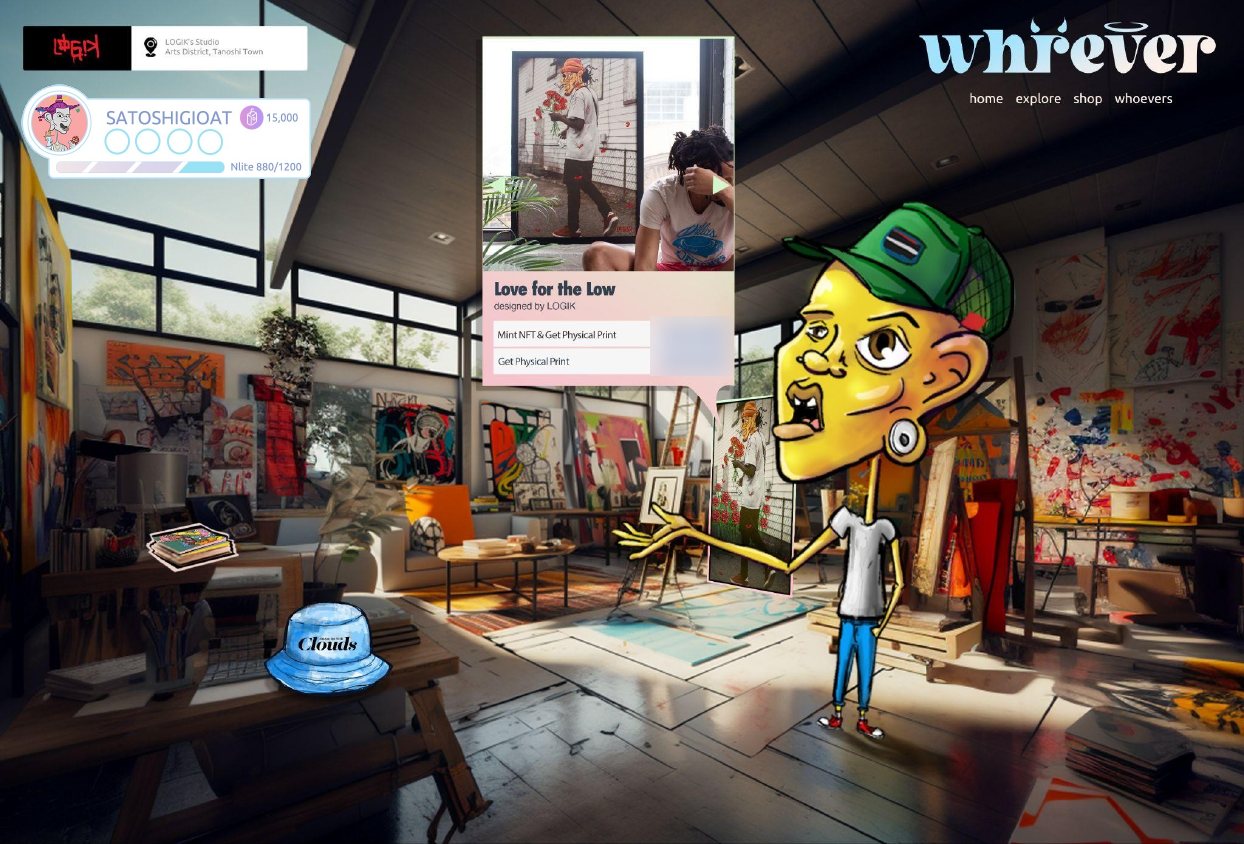
The engineering risk was obvious from the start. On the first page of my notes I wrote: “the 3D world will probably be too much to keep up with from a timing standpoint. Maybe the 2D map is the outer look.” Every new partner meant a new place to design, illustrate and build. The world was beautiful and very expensive per partner.
Version 2: one app for everything you already use (2024–25)
Version 2 kept the core, which was rewards across everything you do online, and dropped what was expensive to make. The 2025 decks don’t mention districts or characters at all. It worked in three steps:
- Connect the services you already use: music, video, streaming.
- Do things across them: shop a drop, play a playlist, order lunch.
- Earn JUICE for all of it, and spend it anywhere on the platform.
The hard problem wasn’t the interface. It was supply. During the CSX process the question we got was the right one: why would a brand like Nike join? Our answer was a sequence, and it shaped the architecture as much as the business:
- Third-party integrations first. Services like YouTube, SoundCloud, Crunchyroll and DoorDash can be integrated through their public APIs, with no negotiation.
- Second-party commerce next. Independent artists and small brands already sell on Shopify. With their permission, we could list their storefronts and take a revenue share, with almost no deal-making.
- First-party partnerships last. Direct deals with the big platforms come once the audience exists, not before.
If the direct deals were slow to come, my answer in the interview was that the data would be its own leverage: “we could be able to tell McDonalds what types of stores or music make people want a hamburger.”
Architecture
The design followed from that sequence. Each kind of partner needed a different integration, so the core stayed small, and everything at the edges was an adapter.
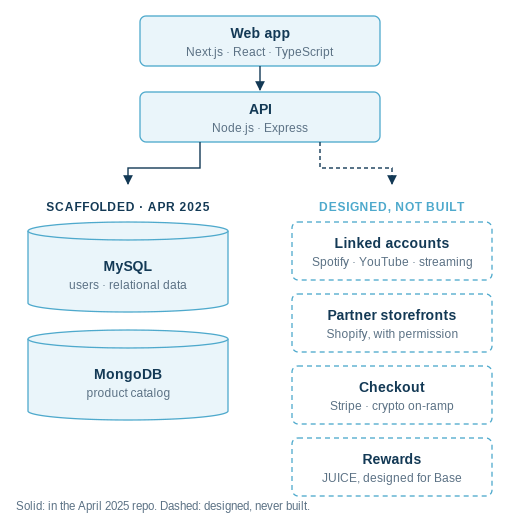
Two databases, on purpose. Accounts, balances and anything that needs transactions and joins belong in a relational store. A product catalog that combines a Shopify sneaker, a print, and a food order doesn’t share one schema, so it went in a document store. The server I started in April opens both (trimmed):
// MySQL Connection (relational data)
const mysqlConnection = mysql.createConnection({
  host: process.env.MYSQL_HOST,
  user: process.env.MYSQL_USER,
  password: process.env.MYSQL_PASSWORD,
  database: process.env.MYSQL_DB,
})

// MongoDB Connection
mongoose.connect(process.env.MONGO_URI)

app.use('/api/users', userRoutes)
app.use('/api/products', productRoutes)
JUICE was designed for Base. In version 1, earning Juice required owning a Whoever. In version 2 it came from activity alone. None of the on-chain part was built.
Fiat first, crypto optional. Most of the brands we wanted had nothing to do with crypto. Checkout had to look like any other checkout, with crypto as an extra way to pay, not a requirement.
What went right
- Reaching the final round of a16z crypto’s accelerator. For two founders and a prototype, that was a real signal that the problem was worth solving.
- Cutting the world when it didn’t scale. Dropping the illustrated map made Whrever buildable by a small team, without losing the core idea.
- A partner plan an engineer could build. “Third-party, then second-party, then first-party” turned a vague go-to-market into a list of integrations, in order.
What went wrong
- The round didn’t close. Everything else follows from that. Without pre-seed funding there was no runway, and in April 2025 development stopped.
- Supply before demand. Our own answer to the Nike question admitted it: the brands we wanted most had no reason to join until the users were there, and the users were waiting on the brands.
What I’d keep
Points that follow you across the internet still make sense to me, and so does the order we planned to do it in: integrate what’s open, earn the small partners, and leave the big ones for when you have an audience.