Full Play: A Record Player That Flips Its Own Record
· mechatronics, arduino, solidworks, capstone, cmu
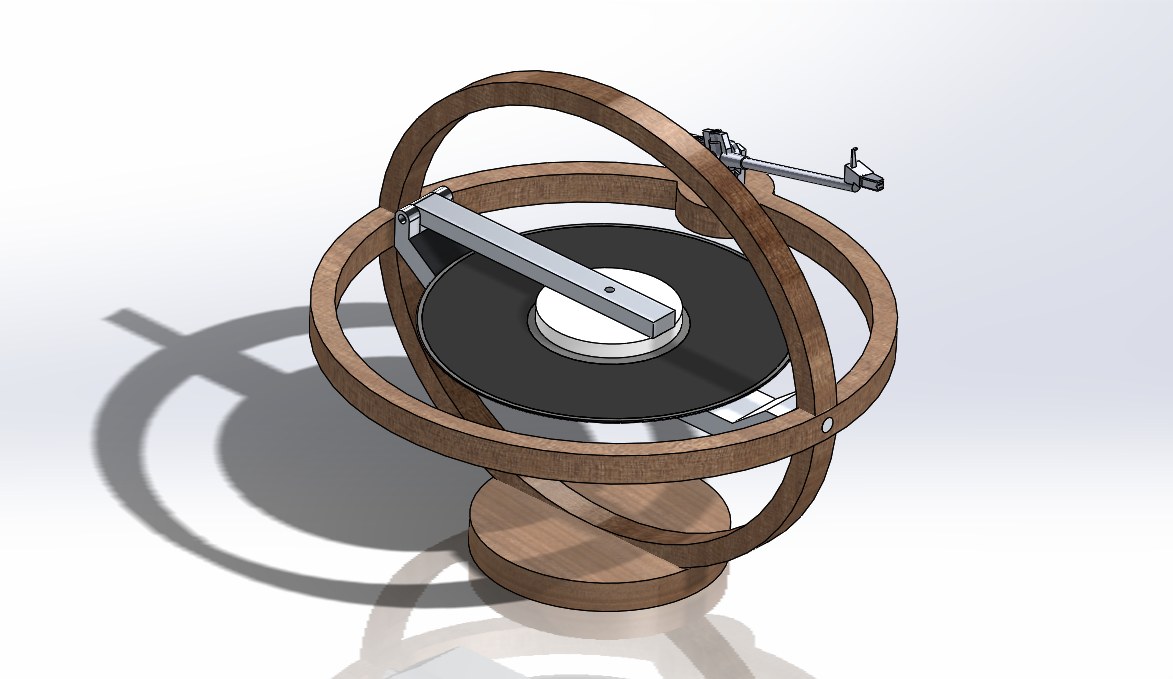
For our senior capstone in 24-671, Electro-Mechanical Systems Design, five of us built Full Play: a record player that plays a whole album without anyone getting up to turn the record over. It won first place in the mechatronics contest that spring.
The team was Mehar Singh, Rodrigo Royo, Edward Holthaus, William Boyajian and me. This post follows the structure of our final poster. The poster and the full 43-page report are at the bottom of the page.
Problem description
A vinyl album is split across two sides. Halfway through, you have to stand up, lift the needle, turn the record over and set the needle down again. Most turntables still work the way they did in the 1980s, while everything else about how we listen to music has changed.
Vinyl didn’t go away, either. Record sales had grown for a decade straight. The appeal is physical: digging through a shop, holding the sleeve, setting the needle down. We wanted to keep all of that and remove only the interruption.
People had tried this before. The Sharp VZ of the 1980s played both sides by holding the record vertically inside a boombox, and it looked like one. Linear-tracking decks like the Technics SL-QL1 could move the needle anywhere, but in our research the tracking servo’s vibration cost them sound quality. Neither looked like something you’d want as the centerpiece of a room, and that was a requirement for us.
Customer needs and specs
We surveyed CMU students and the DJs at WRCT, the campus radio station, several of whom play mostly vinyl on air. We got 33 responses in a few days. About 80% owned a turntable. Two answers changed our plans. Most people thought picking individual songs was against the point of vinyl: they wanted the album, start to finish. And fewer than a quarter owned a customized turntable.
That left six requirements, in order of importance:
- Never scratch the record.
- Never damage or warp it during the flip.
- Make loading a record easy.
- Keep it table-sized.
- Don’t let the flip take too long.
- Make it beautiful.
| Metric | Marginal | Ideal |
|---|---|---|
| Unit size | 20 × 20 × 20 in | 16 × 16 × 16 in |
| Flip time | 20 s | 5 s |
| Time to load a record | 10 s | 2 s |
| Visible or audible damage | 0 scratches | 0 scratches |
Concept generation and selection
We split the problem into six subsystems: spinning the record, the needle mechanism, the flip, the microcontroller, the actuators, and position tracking. We sketched options for each, then combined them into three whole concepts:
- A: Lift and Flip. A robot arm does what a person does: lift the record clear, turn it over, set it back down. It’s intuitive and reuses a normal turntable, but it’s a lot of precise motion right next to the record.
- B: Linear Tracking. No flip at all. A second needle underneath, facing up, plays side B while the record spins the other way. It’s the fastest switch, but getting the right needle pressure upside down would have been hard, and sound quality would have suffered.
- C: The Globe. The record hangs inside two rings like a globe. A vertical ring stands on the base and holds a horizontal ring halfway up. An arm clamps the record level with the horizontal ring, and the whole arm turns over in place.
We scored all three against the Sharp VZ in a Pugh matrix, and all three beat it. A weighted selection matrix then picked the Globe by a wide margin. It was the largest design, but it was also the only one people wanted to look at, and the flip was a single rotation about a single axis.
Concept description
Overall design
The vertical ring and base carry everything. The horizontal ring holds the flip axis. The record arm spans the horizontal ring, with the platter motor underneath and a top platter that threads down to clamp the record. The needle mounts on the horizontal ring and swings out over the record.
Needle sub-assembly
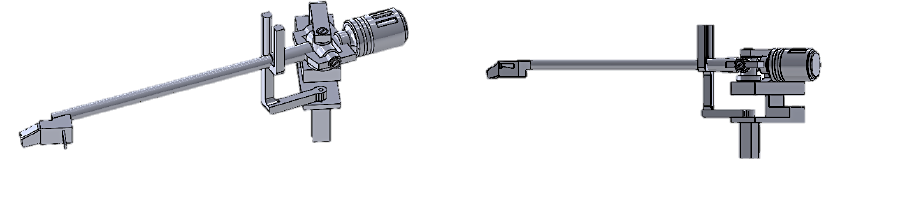
The needle takes two actuators. A servo lifts it by pressing down on the counterweight at the back of the tonearm. Thanks to the lever geometry, the servo only needs about 0.09 kg·cm against its 1.2 kg·cm rating, a factor of safety of about 13. A DC motor with an encoder swings the arm, and the encoder is how the system always knows where the needle is.
The encoder had its own small sketch, running on its own board. It counted quadrature ticks in interrupts and reduced the needle’s position to four zones (rest, approach, on the record, past the end), signalled on three digital lines. We calibrated the zones by hand: rest at tick 20,000, the start of the record at 20,450, the end at 21,069. Starting at 20,000 meant the count could never roll under zero.
The firmware
The main sketch on the Arduino Mega was a state machine that read those zone lines:

The flip itself is short. The detail that matters is the last line: once the record is upside down, the platter has to spin the other way for the needle to see the grooves running in the right direction.
case FLIP:
  RecordSpinMotor->run(RELEASE);          // stop the platter
  delay(1000);
  if (!flip) {
    for (k = 0; k <= 170; k += 1) { FlipServo.write(k); delay(15); }
    flip = true;
  } else {
    for (k = 170; k >= 0; k -= 1) { FlipServo.write(k); delay(15); }
    flip = false;
  }
  active_state = RUNNING;
  break;

// …and in RUNNING:
if (!flip) RecordSpinMotor->run(FORWARD);
else       RecordSpinMotor->run(BACKWARD);
For the expo, the end of a side was a button press instead of automatic detection, so we could demonstrate a flip on demand. The report’s plan for automatic detection was a force sensor under the needle, since the run-out groove at the end of a side pushes back much less than the music.
Our past prototypes
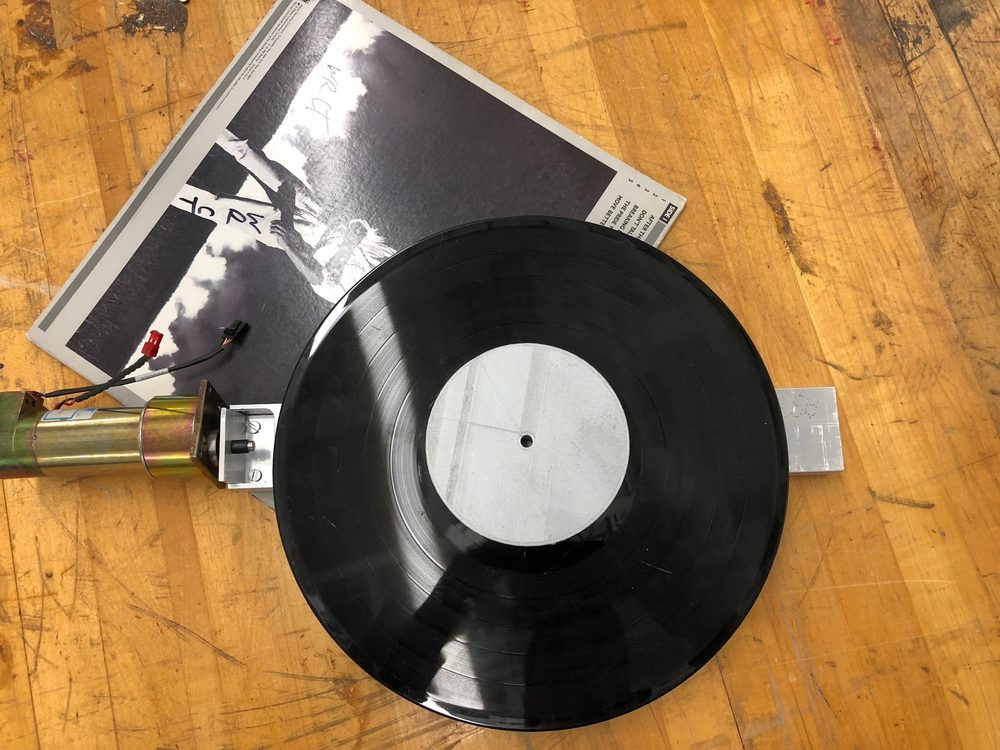
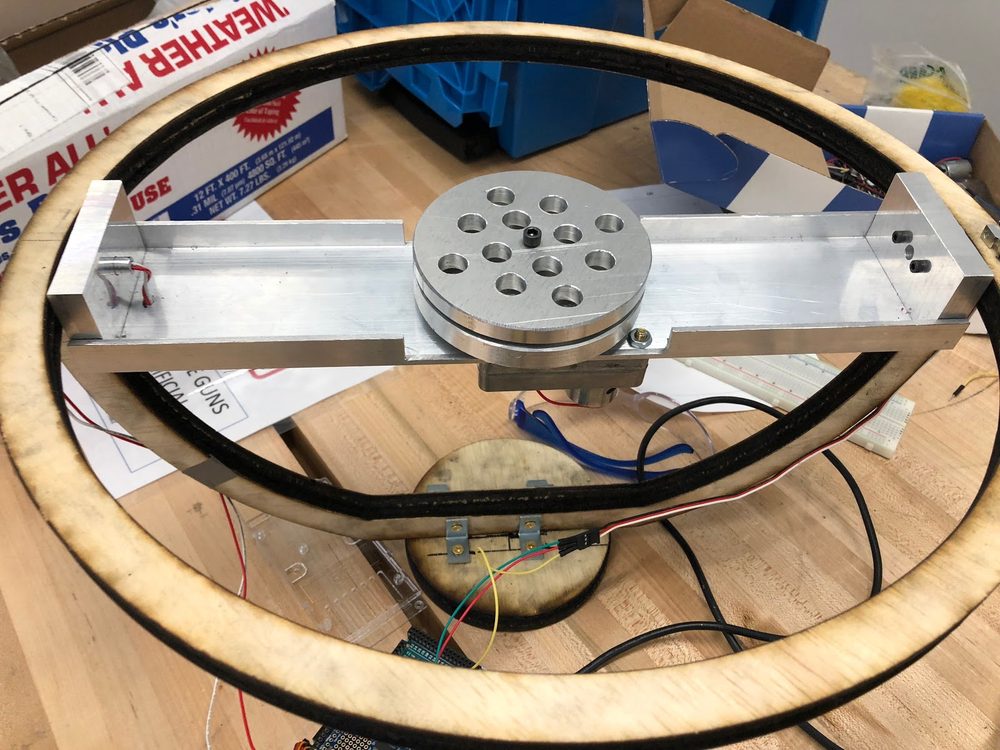
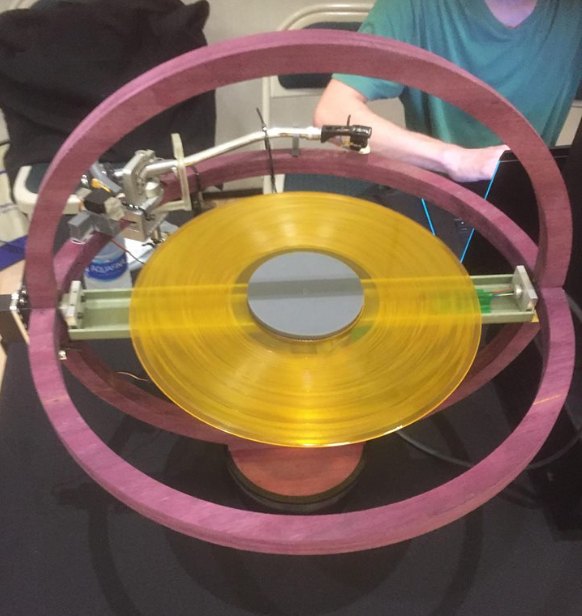
Every iteration was mostly about weight, because everything on the arm has to be flipped. Prototype I’s hollow aluminum beam and large printed platters were very heavy. Prototype II cut the beam into a U-channel and swapped in small aluminum platters, but added a platter motor that was far more powerful than it needed to be. The final arm is a fiberglass U-channel with small printed platters and a much smaller DC motor. It was still strong, at a fraction of the weight, and much easier to flip. A SolidWorks study put the arm shaft at a factor of safety of about 18.
The rings are purpleheart, routed from a single sheet. It’s stiff (an elastic modulus of about 20 GPa against about 49 MPa for the balsa we first modeled with), and it’s very hard. That made it hard to machine, and we fought heat and cracking while cutting and drilling it.
Results and analysis
Levelness after a flip. A record that isn’t level after the flip sounds worse and can get scratched. We measured each flip with a digital level. Across the test flips, the error from a perfect 180° stayed under about 0.7°, small enough not to affect playback. The lesson was clear, though. The next version would flip with a DC motor and encoder under closed-loop control, instead of trusting a hobby servo’s built-in position loop.
Spinning speed. We checked 33⅓ rpm three ways: ticks per second from the motor’s encoder, a handheld tachometer, and a feedback loop in the firmware that compared measured ticks per second against a target.
Final prototype testing
Deflection. The needle presses on the record with about 3 grams, and our record is only supported at the center. Hand calculation put the worst case, at the outer edge, at 0.0178 inches. SolidWorks came in lower still: 0.003 inches six inches from the center. Both were small enough to ignore.
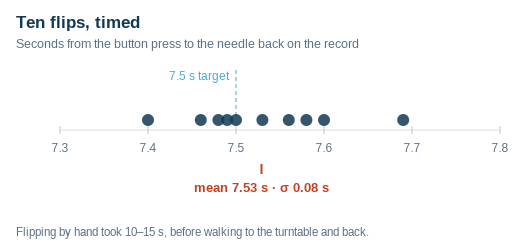
Flip time, and the “wow” factor. We didn’t just want the fastest flip. We wanted the one people would stop and watch. We showed 50 people needle and flip timings of 2, 5, 7.5 and 10 seconds. 7.5 seconds was the favorite for both, so we tuned to that:
Sound. By ear, playback was easily comparable to a normal turntable. The needle came from a quality deck, and the speed held at 33⅓. The one real flaw was our bottom platter: the 3D print had warped slightly, so the record wobbled and skipped near the outer edge of each side.
Conclusion
The final prototype did everything we set out to do. It played side A, lifted the needle, flipped the record, reversed, and played side B, all at the press of a button, without scratching anything.
What we’d fix is mostly hardware we’d buy better:
- The platters, by reprinting them flat or machining them, to stop the wobble.
- The needle encoder, which was cheap and overshot often enough that we kept resetting the Arduino to re-home it.
- The servos and the Mega. One servo burned out during Prototype II. The flip servo we planned for the final turned out to reach only 120°. A short fried the Mega. Buy spares of the critical parts is the lesson we wrote down.
- The cables. For something meant to be the centerpiece of a room, the wiring should run down the rings into the base, with the button set into the wood.