Two Places the Databricks Exam Guide Disagrees with the Docs
· databricks, certification, data engineering, unity catalog
On Friday I passed the Databricks Certified Data Engineer Associate exam (credential). I only used docs.databricks.com and the official exam guide because information online was usually stale.
That rule did two useful things. It forced me to use current product names, like Lakeflow Jobs, Lakeflow Spark Declarative Pipelines, and the pyspark.pipelines module instead of the old dlt, which a lot of older study material still uses. It also meant that whenever the guide and the docs said different things, I noticed. They do, in two places.
Erratum 1: DENY in Unity Catalog
The guide (May 4, 2026 version), Section 7, Governance and Security:
Configure access controls using the UI and SQL by applying GRANT, REVOKE, and DENY privileges to principals…
The docs: the DENY reference page says the statement applies only to the hive_metastore catalog and its objects. The page on working with the legacy Hive metastore lists “no support for DENY” as a difference, because Unity Catalog follows least privilege: anything not granted is denied implicitly.
So in Unity Catalog, access is GRANT and REVOKE plus group membership. There’s no DENY statement to override a grant. If you learned table ACLs on the legacy Hive metastore, this is exactly where old habits will steer you wrong.
Erratum 2: pull requests from a Git folder
The guide, Section 5, Implementing CI/CD:
…committing and pushing changes, and creating pull requests using Databricks Git integration.
The docs: Git folders handle cloning, branching, committing, pushing, pulling, merging, rebasing and resolving conflicts, all inside the workspace. The pull request itself is the exception. The Git folder limits page says you create a pull request and merge through your Git provider.
Neither difference is large. But both are the kind of thing a multiple-choice question can hinge on. And both are invisible if your study material is a summary of the guide instead of the docs it’s supposed to describe.
How I studied
The guide weights its seven sections very unevenly, so I studied in order of weight rather than in order of the guide. For each section I worked through it as a conversation, with a docs link behind every claim, and answered practice questions at the end of each one (30 in all). Then came timed practice sets. I had Claude write them under the same rule: every question grounded in, and cited to, a docs page.
| Set | Questions | What changed |
|---|---|---|
| I | 49 | Weighted to the real section percentages |
| II | 49 | Syntax-heavy, deep on Declarative Pipelines |
| III | 45 | Ingestion and transformation weights doubled |
| IV | 49 | Harder: multi-fact questions, architecture trade-offs |
| V | 49 | Hardest set; near-miss distractors; balanced answer key |
| VI, VII | 20 each | Twin timed sittings at 9/10 difficulty |
That’s 281 questions in total. I’m not claiming I answered every one under exam conditions. The point of having that many was not to run out.
The bug in my own practice exams
Four sets in, I noticed how often the answer was B, so I counted. In Sets I through IV, the correct answer was B on 161 of 192 questions: 84%.
With four options, B should be right about a quarter of the time, or 48 questions. Getting 161 or more by chance has odds of roughly one in 10⁶⁵. It wasn’t chance. It was a habit of whatever wrote the questions, and it meant that “when in doubt, pick B” would have scored about 84% on those sets without reading a single question. Four sets of practice, and the scores couldn’t tell me what I knew.
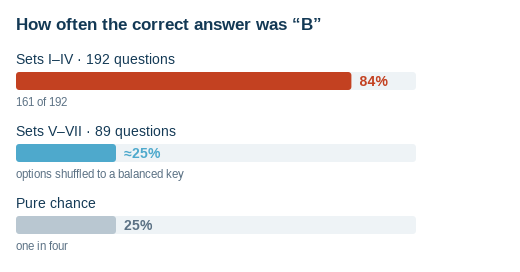
From Set V on, each question’s options were shuffled to hit an even target: 13/12/12/12 across A–D for Set V, and 5/5/5/5 for each of the 20-question sets. The lesson carries beyond studying: if you generate your own test data, check its distribution before you trust what it tells you.
What it proves
A pass shows I can recall how Databricks works, and that’s a real but limited claim. It says nothing about whether I can build something that runs every day and stays correct when the data changes underneath it. So that’s the next project: a pipeline that uses all of it.