Bloombox: Designing a Wooden Speaker Backpack
· product design, mechanical engineering, acoustics, 3d printing, patents
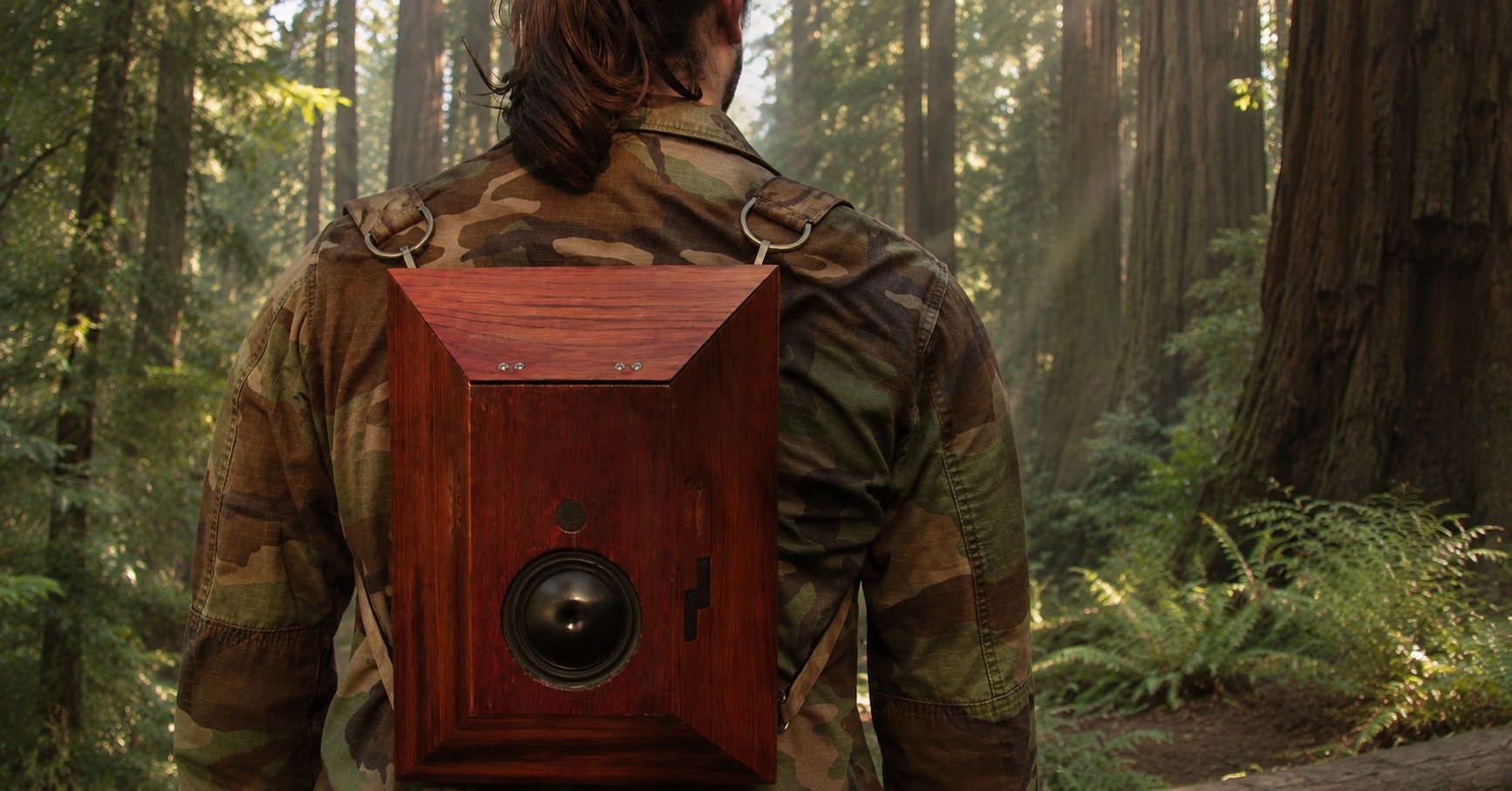
This morning I filed a design patent application for the Bloombox. It’s a backpack built from hardwood. It carries a 13-inch MacBook, has a hinged compartment for pencils and cables, and is also a Bluetooth speaker. The sound comes from an acoustic chamber whose shape is the reason the patent exists.
I’ve been building versions of it since 2015. This post takes the current one, v3, apart from the outside in. First, though, here’s how it got here.
Three Bloomboxes
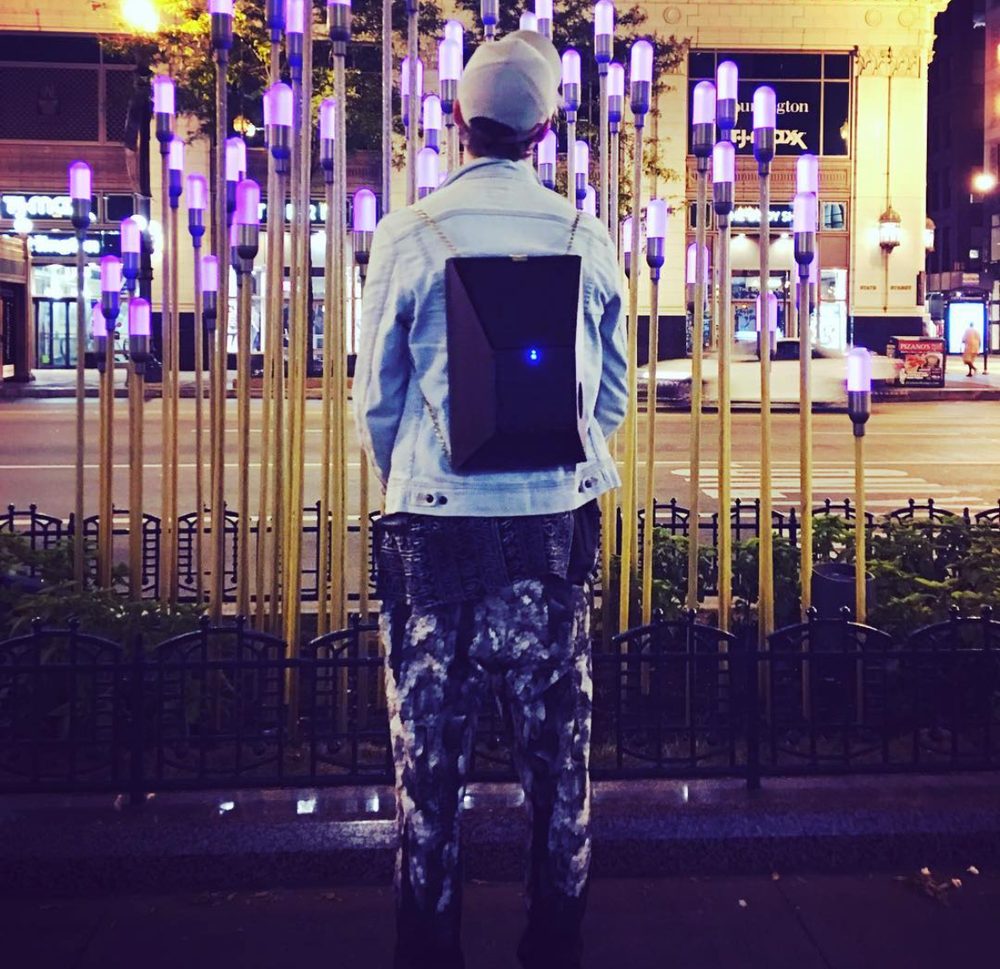
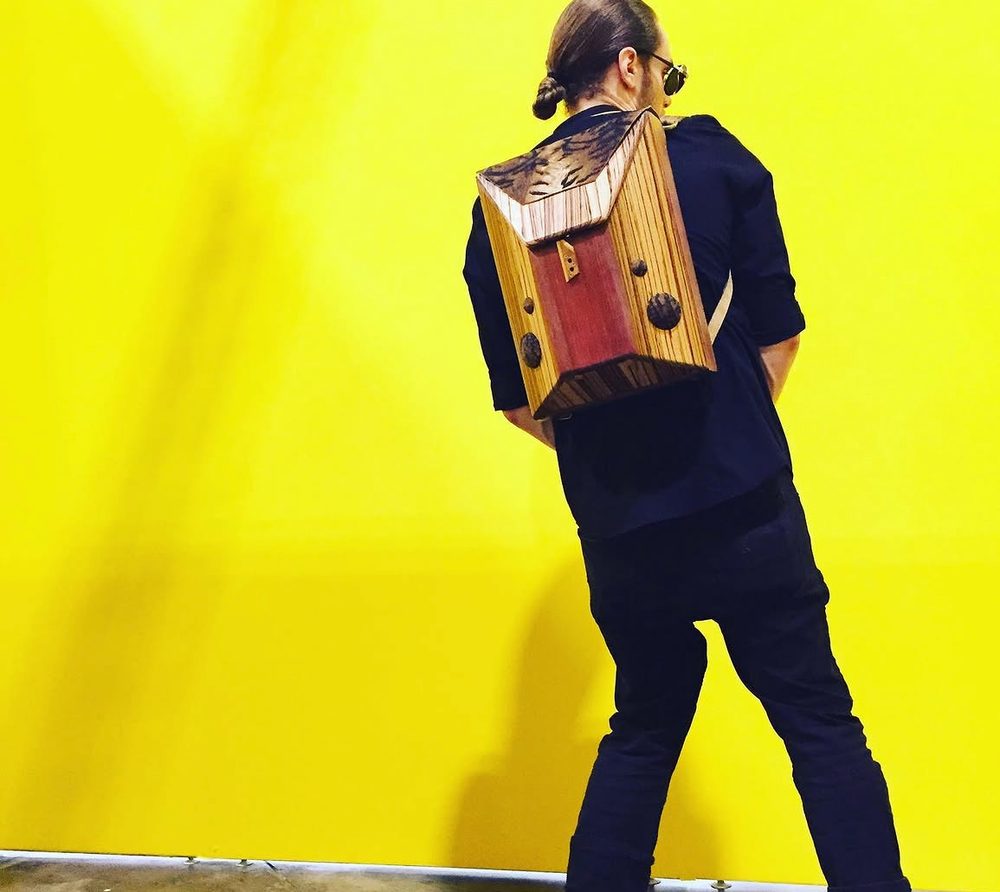
v1 was the proof of concept: black, angular, one blue status light. v2 turned it into a statement piece. It had zebrawood panels, a purpleheart face, a tiger-print flap, brass latch hardware and four speakers. It went to galleries and art fairs. It also weighed about fifteen pounds, which is a lot to carry on your back.
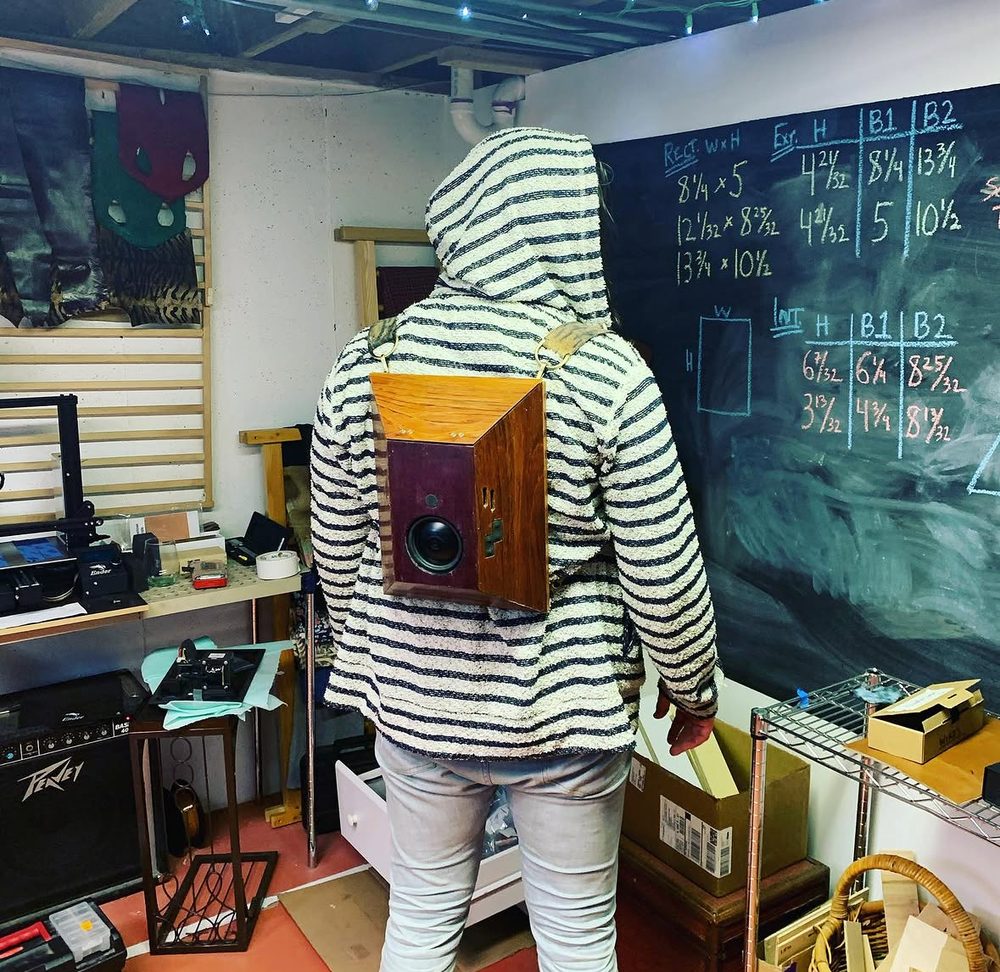
v3 is a different machine inside. The face is still purpleheart, and the bag still opens at the top, but almost everything else changed. Starting in 2019, Ken Rivera and I redesigned it from scratch, and from January 2020 we kept a week-by-week build diary. Most of what follows comes from that diary.
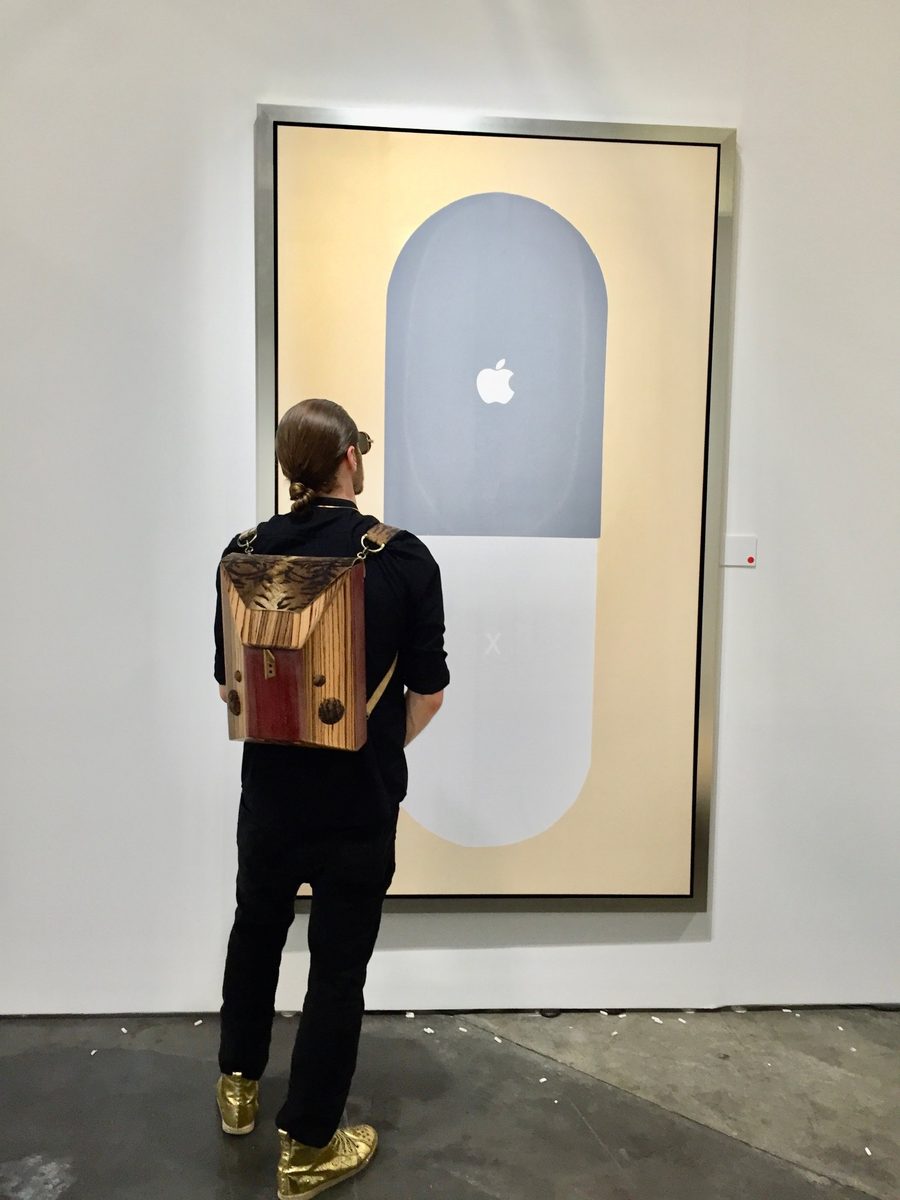
Layer 1 · The shell
The biggest lesson from v2 was weight. v3’s walls are 3/8 inch thick, and the whole bag weighs about six pounds empty, less than half of v2. I chose the wood by hardness, for two reasons. Walls that thin only work if the wood can take daily knocks. And on a speaker, the walls are part of the sound.
The standard measure of hardness is the Janka test: the force needed to press a steel ball halfway into the wood. Divide that by the wood’s weight and you get a rough figure for how much durability each pound carries:
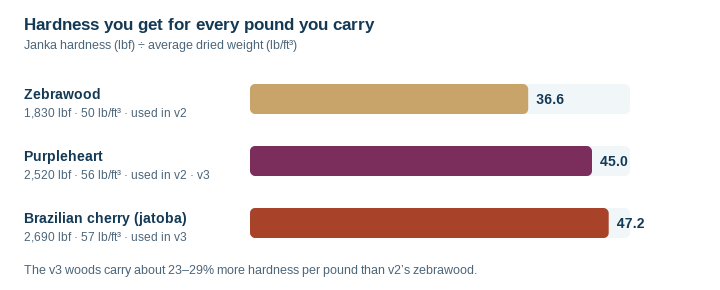
Purpleheart and Brazilian cherry (jatoba) are both far harder than familiar hardwoods like oak or maple. Per pound, they’re harder than the zebrawood v2 was mostly made of. That’s what lets the walls get thinner without the bag getting fragile.
Hardness matters just as much for the sound. A speaker pushes on the air inside its enclosure, and the enclosure pushes back. Soft, flexible walls vibrate along with the music and add a muddy sound of their own. Hard, dense walls barely move, so what you hear is the drivers and the chamber, not the box. For a speaker you wear, that’s the rare case where the stronger material also sounds better. It also helps that the purple and the red-brown look great next to each other.
v3 was prototyped in plywood first, and the plywood taught the most useful lesson of the build:
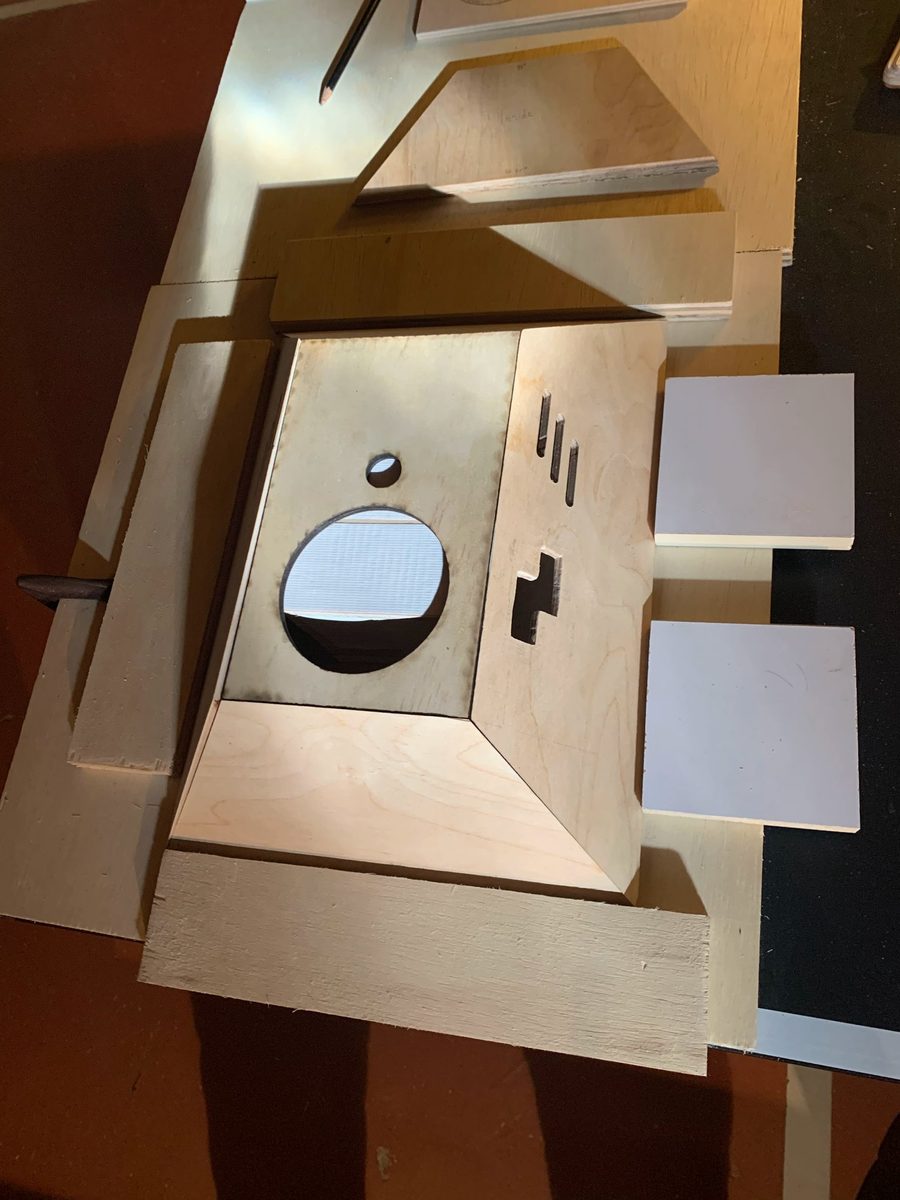
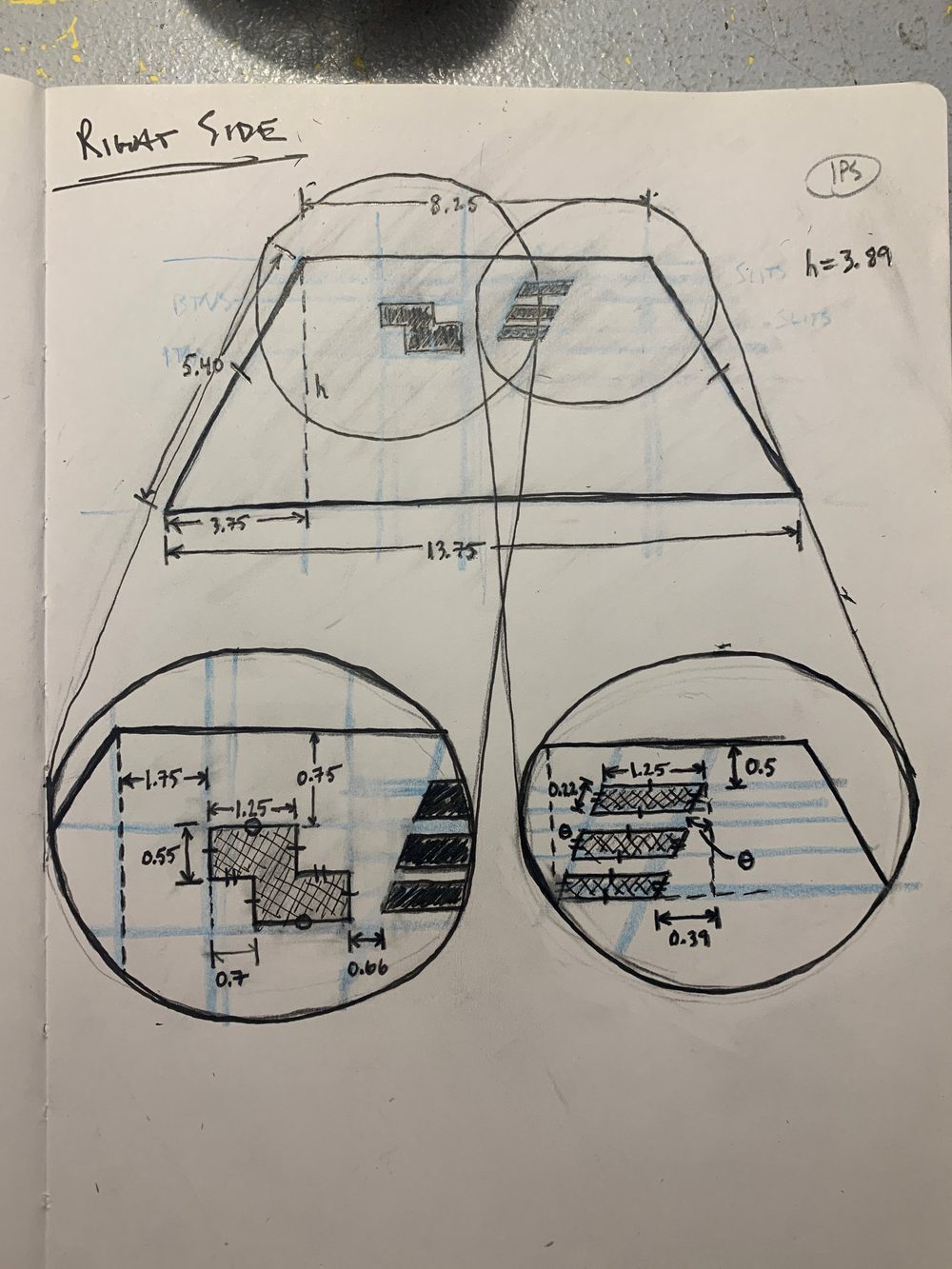
The reason pieces are not fitting properly is because the wood is not ¼” exactly - it’s roughly 0.26 - 0.28”.
That’s from the diary, April 2020. A few thousandths of an inch per board doesn’t sound like much. But every piece in this box is mitered to every other piece, so each small error passed into the next joint. The last piece to go on, the front, inherited all of it. It’s tolerance stack-up, the same problem a machinist plans around. The fix is to measure every board and cut to its real thickness, not the one on the label.
Layer 2 · The chamber
The speaker doesn’t fire into an ordinary box. It fires into a chamber shaped to make the sound bigger. I describe it as blossoming: narrow at the bottom, opening toward the top.
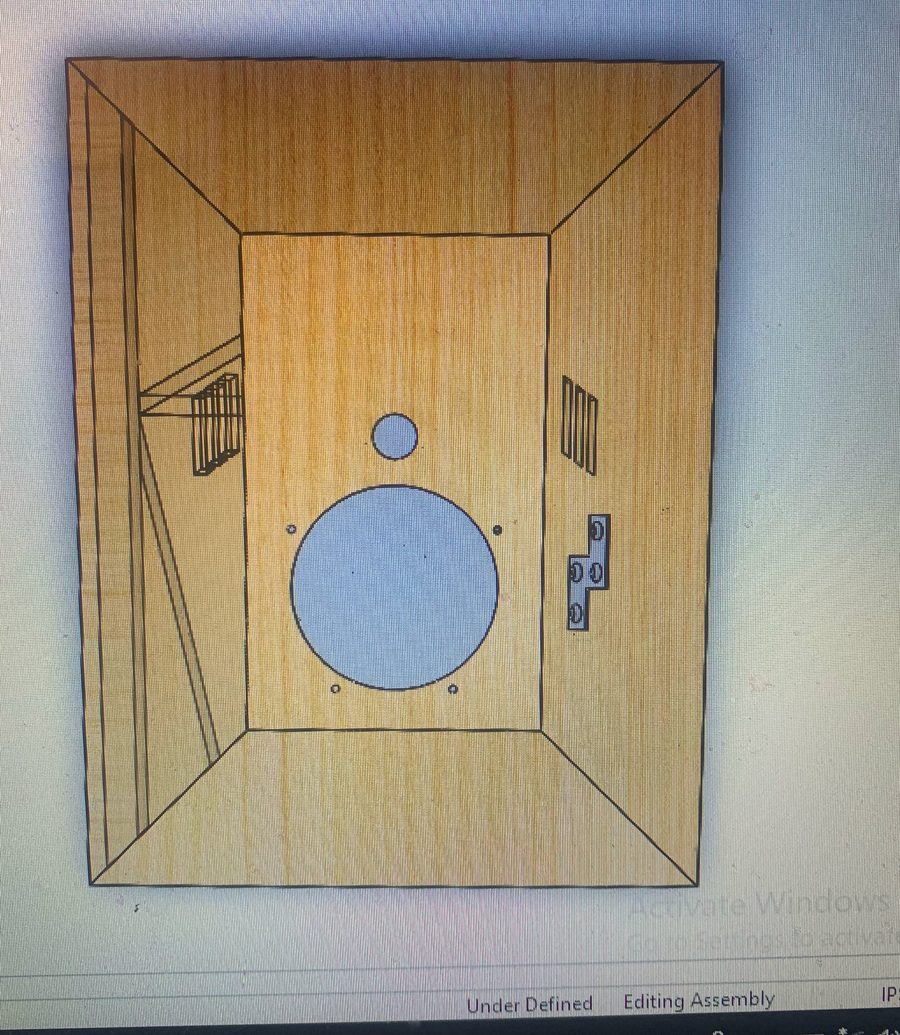
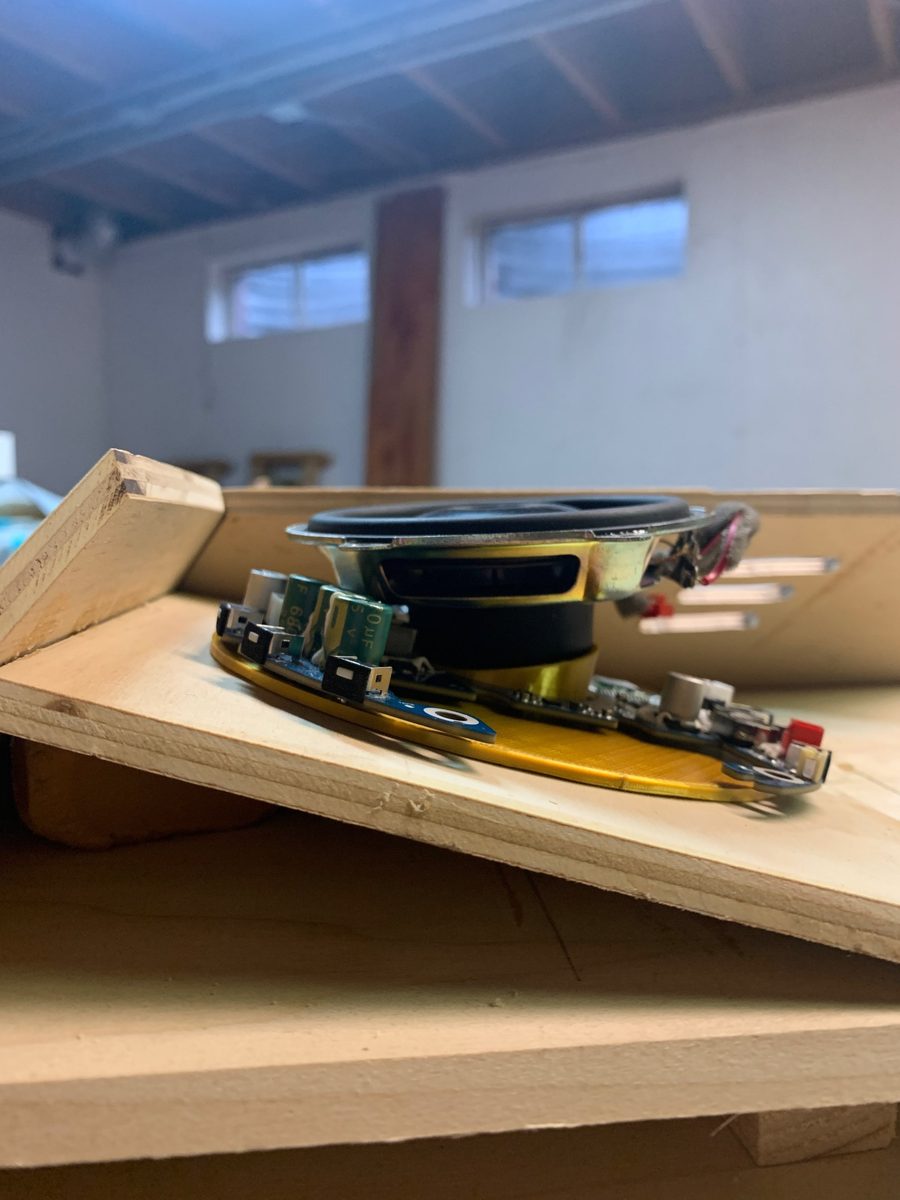
The two rules for the shape:
- No two walls are parallel. Parallel walls let sound bounce straight back and forth, which builds up standing waves at particular frequencies. Angling every wall breaks that up.
- Every wall tilts toward the top. Taking the front panel as the reference:
| Wall | Tilt | What that means |
|---|---|---|
| Front | 0° | The reference; both drivers are mounted here |
| Back | 19.92° outward | Front and back are 19.92° from parallel |
| Bottom | 30.6° inward | |
| Top | 19.19° outward | Top and bottom are 11.41° from parallel |
| Sides | 33.95° inward |
Where things sit matters more than their exact sizes:
- The sub/mid goes low. Its 3½-inch hole is centered about 2½ inches from the bottom. Low frequencies get the longest path through the chamber before they leave.
- The tweeter goes high. Its ¾-inch hole is 3¼ inches from the top. High frequencies don’t need as long in the chamber.
- Each driver hole matches the driver. A bigger hole leaks sound around the driver; a smaller one muffles it.
- The sound leaves through slots near the top of each side wall. They’re about 1¼ inches long and ¼ inch wide: large enough to let the sound out, small enough not to undo the chamber’s effect.
The first full sound test in the new chamber was, by my estimate, about twice as loud as the same drivers in their original housing.
Layer 3 · The electronics
I didn’t design an amplifier. I took apart an off-the-shelf Bluetooth speaker and built around its board. That meant fitting someone else’s circuit board into my geometry.

The buttons. The board’s power, volume and Bluetooth buttons are soldered to its face, and the board lives inside the chamber. So I desoldered all four and wired new ones on leads out to the side of the bag. Even that step needed better tools: desoldering a factory board took an iron that reaches 450 °C and a wide bevel (“hoof”) tip, to get enough heat into the joint.
The mounts. Every part that holds electronics was designed in SolidWorks and printed on my Ender 3:
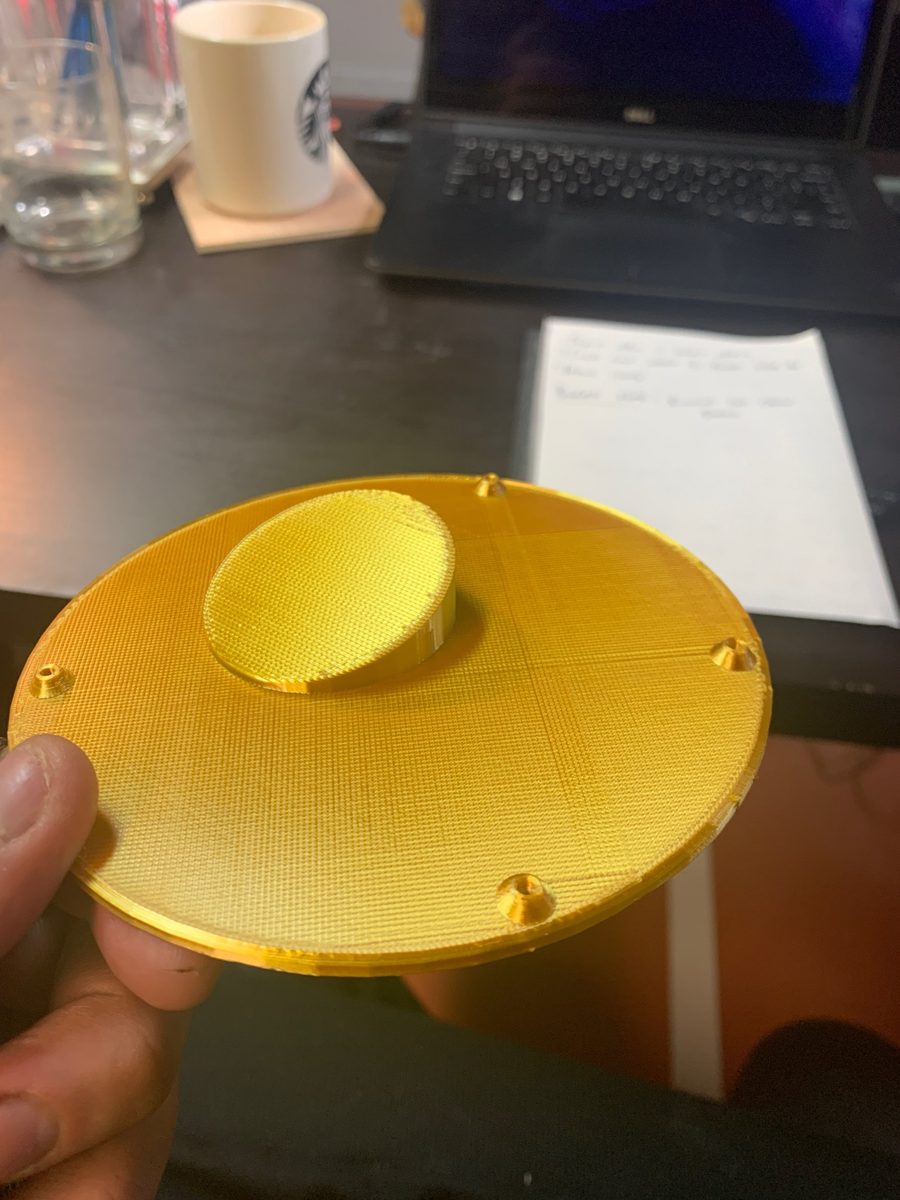
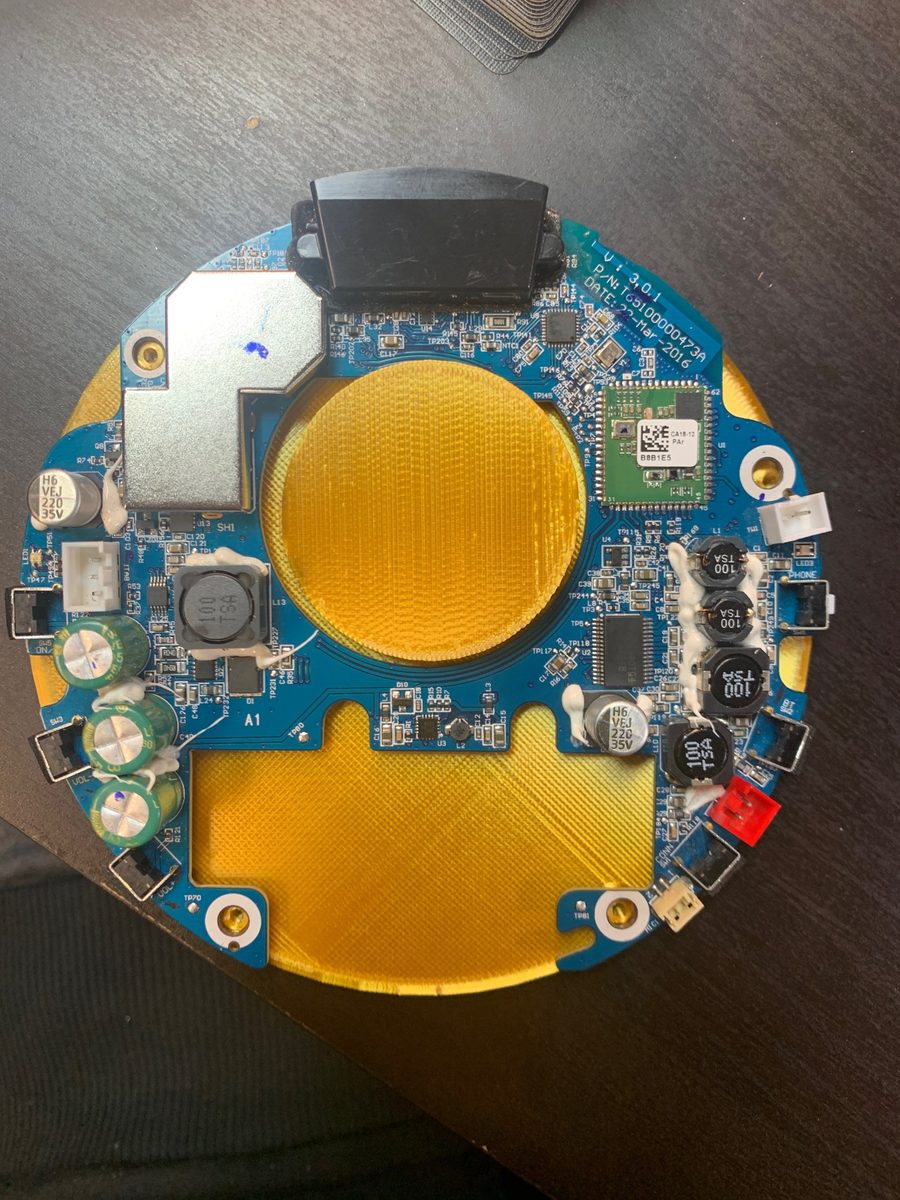
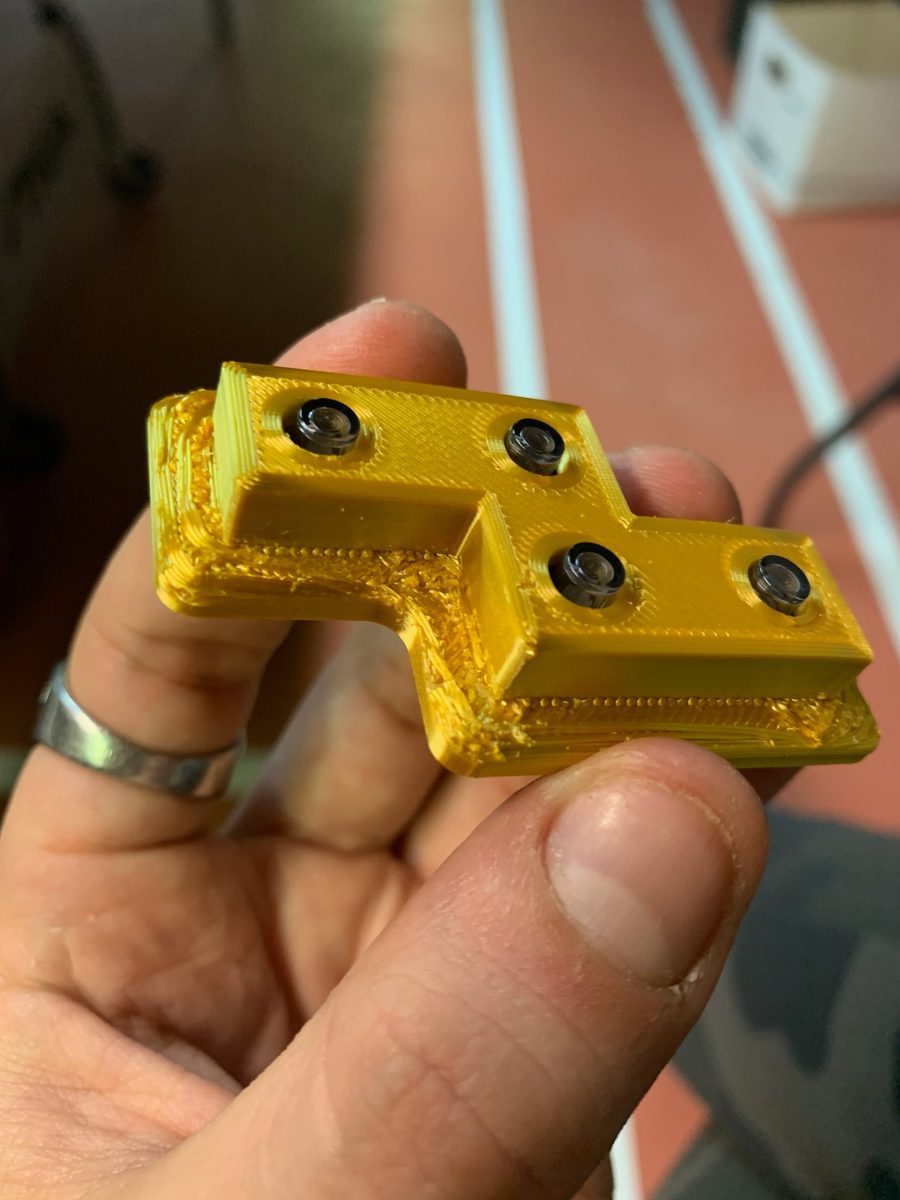
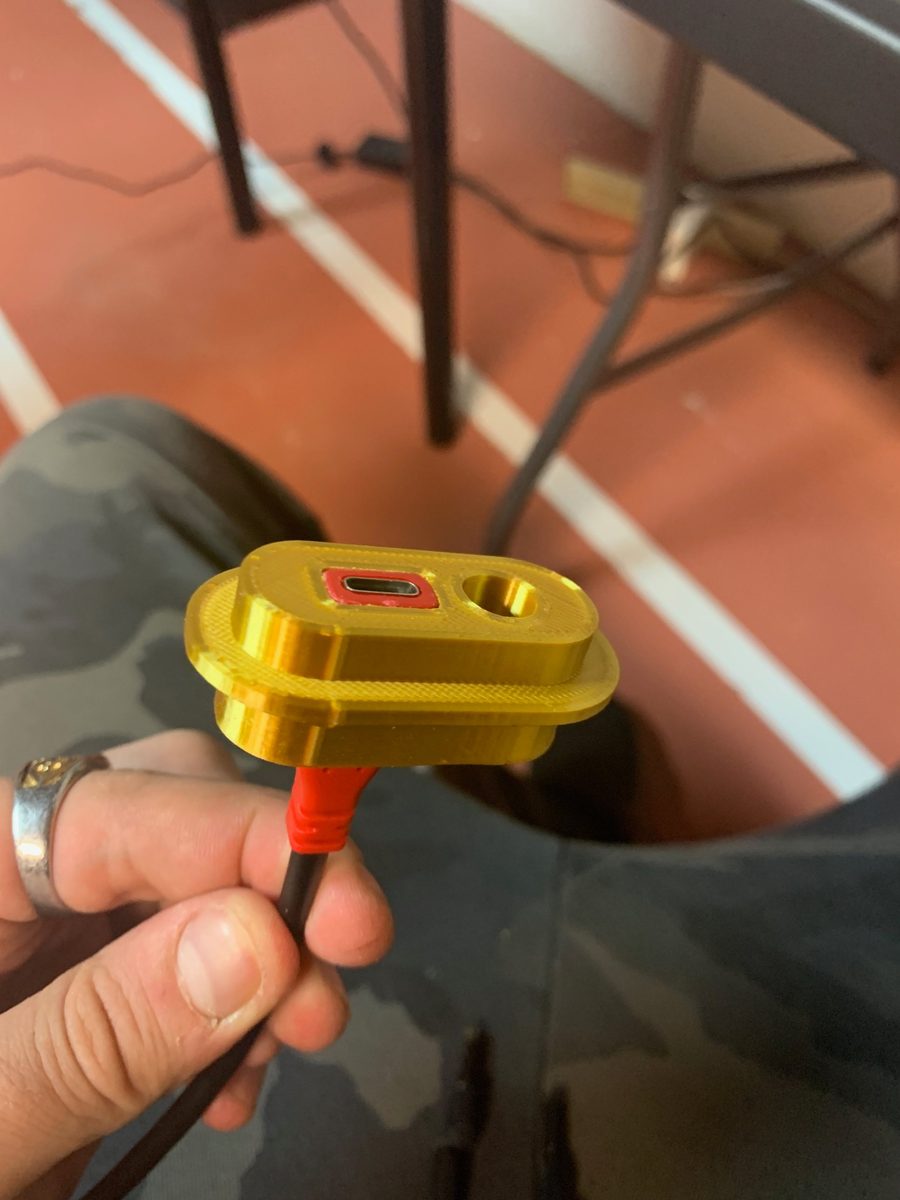
- Board mount. The board sits on standoffs, fixed with threadlocked machine screws so the bass can’t shake them loose.
- Button housing. It’s shaped like a Tetris piece, and it fits the matching cutout on the side of the bag.
- Port mount. It holds a USB-C charging socket and a 3.5 mm aux jack on the shelf inside the compartment. Right-angle extension cables bring both ports up there from the board.
- The battery didn’t fit where we planned it. It moved to the empty space under the chamber, held on a glue block cut at 30.6°, the same angle as the chamber’s bottom wall.
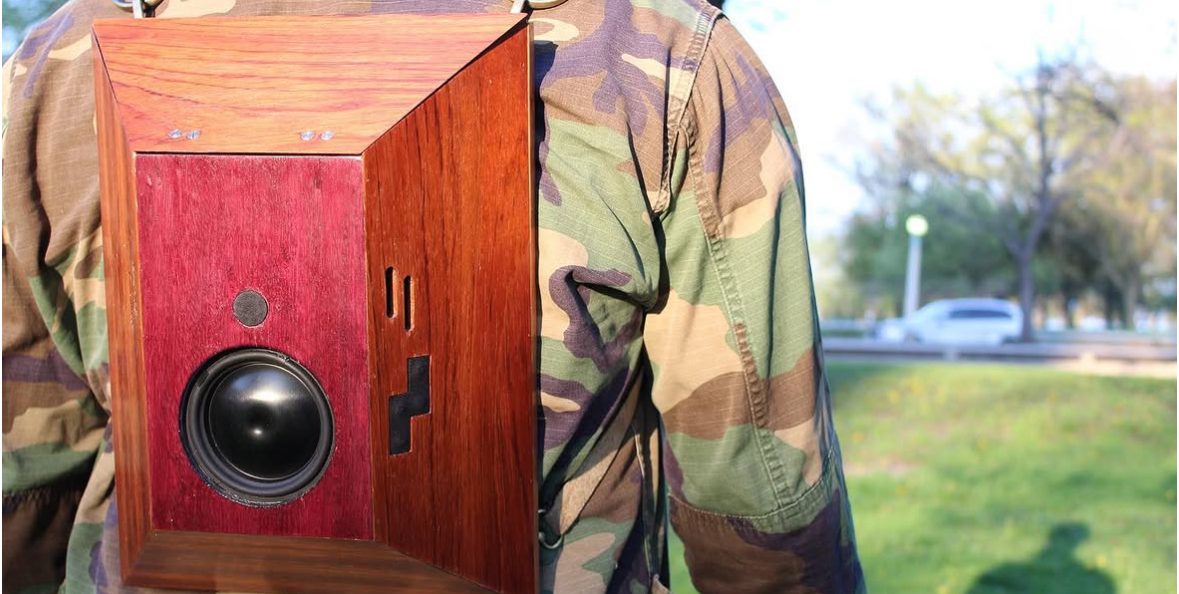
On a full charge it plays for about four hours at 100% volume.
Layer 4 · The door
The compartment at the top opens on a hinge, and the hinge was its own engineering problem. The lid meets the front of the bag at a mitered angle. A normal hinge would show on the outside. And the hinges made to mount inside a box are bulky mechanisms that don’t fit a wall 3/8 inch thick. The hinge we needed didn’t exist.
So Ken and I designed an interior-facing slot hinge. It has two leaves on a 2 mm shaft. One leaf is screwed to the lid through round holes. The other is screwed to the front through slots, using shoulder screws that can slide along them. The slots let the hinge set itself to the mitered geometry and control how far the lid opens. Nothing shows on the outside. Small magnets set into the lid and the back hold the compartment shut.
| Part | Size | Made from |
|---|---|---|
| Fixed leaf | 25.4 × 6.5 × 2 mm | HP Multi Jet Fusion nylon 12, dyed black |
| Slotted leaf | 25.4 × 18.5 × 2 mm | HP Multi Jet Fusion nylon 12, dyed black |
| Shaft | 2.03 mm diameter | HP Multi Jet Fusion nylon 12, dyed black |
| Screws | 4-40, ⅛″ shoulder | 18-8 stainless steel |
Layer 5 · Straps and sleeve
The straps are custom-made, patterned boar skin with brass hardware, and building v3 meant learning leatherwork from scratch. The sleeve the MacBook slides into is lined with leather too, and that lining caused one of v3’s best failures. Leather glued onto plywood with wood glue warped the panel badly as it dried. The options on the list were leather glue instead of wood glue, a better grade of wood, or neoprene instead of leather. It was a small lesson in how materials pull on each other as they dry.
The field test
In June 2020 I took a finished v3 prototype to Los Angeles. The subwoofer broke after the first day. The diary has the post-mortem: the sub had no grill, so the cone took a few punctures. I patched them with tape, and the added weight eventually kept it from producing low frequencies at all. And there was no rubber between the sub and the wood, so mechanical vibration went straight into the panel.
Two good things came out of that trip. The button wiring, which I’d worried about from the start, held up perfectly. And people loved the bag even once it had stopped bumping. The fixes that came out of it: a grill for the sub, and rubber isolation between the sub and the wood and behind its magnet.
Why a design patent
The point of protecting the chamber was never to stop people from building speakers. It was to stop someone from copying the Bloombox. A design patent covers how an object looks, not how it works. For the Bloombox, the look and the function are the same thing: the blossoming, mitered shape that makes it recognizable is also what makes it loud. So today’s application is for the design of the speaker itself.
Spec sheet
| Bloombox v3 | |
|---|---|
| Body | Purpleheart & Brazilian cherry, 3/8″ walls |
| Weight | About 6 lb empty (v2: about 15 lb) |
| Carries | A 13″ MacBook, plus a hinged compartment for pencils and cables |
| Drivers | One sub/mid + one tweeter, in a blossoming acoustic chamber |
| Input | Bluetooth, 3.5 mm aux |
| Charging | USB-C |
| Battery | About 4 hours at 100% volume |
| Hardware | Custom 3D-printed mounts, custom interior slot hinge, magnetic latch |
| Straps | Patterned boar skin, brass hardware |
Credits
Bloombox 3.0 was designed and built by Jack Kasbeer & Ken Rivera, 2019–2021. More photos are on Instagram (@satoshigoat).